
The Artists in the Room: Jane Chesson

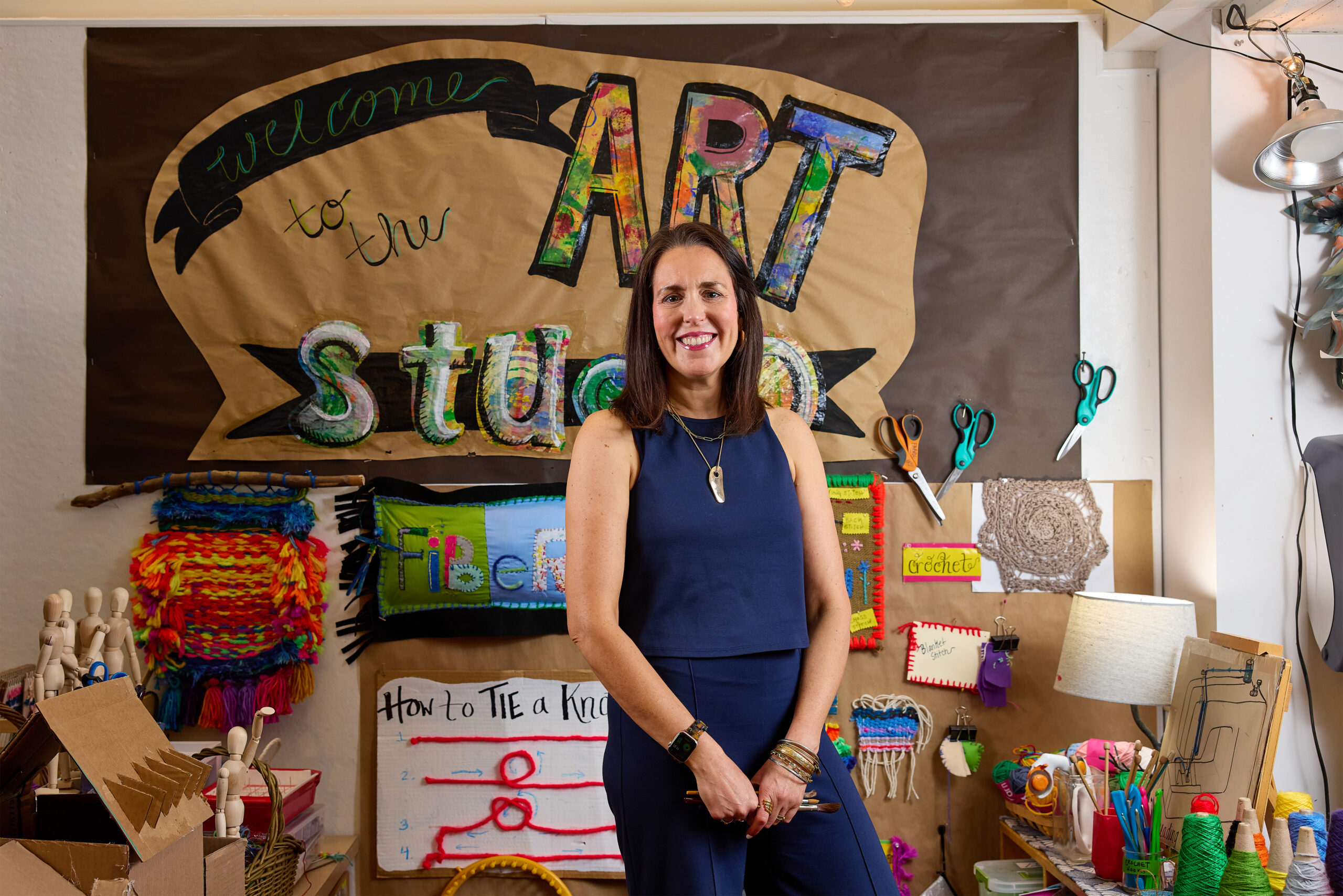
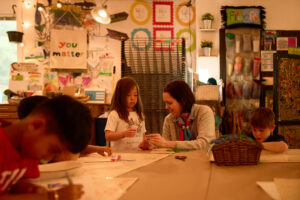
In Jane Chesson’s art room, a four-year-old mixes different hues of paint with rapt attention. Another student moves between clay and cardboard, while a peer across the room studies a classmate’s larger-than-life tower and asks how it was made. There is no single prescribed project taking shape on every table, no model waiting at the front of the room to be mimicked or copied.
Chesson teaches visual art in Westtown’s Lower and Middle Schools, working with students at the beginning of their creative process as four-year-olds and then meeting some of them again years later in their preteen/teenage eras. Her classroom is grounded in Teaching for Artistic Behavior (TAB), an approach developed by professional artists who began teaching children the way artists actually work in their own studios. The premise is direct: the child is the artist, and the classroom is the studio.
Chesson teaches visual art in Westtown’s Lower and Middle Schools, working with students at the beginning of their creative process as four-year-olds and then meeting some of them again years later in their preteen/teenage eras. Her classroom is grounded in Teaching for Artistic Behavior (TAB), an approach developed by professional artists who began teaching children the way artists actually work in their own studios. The premise is direct: the child is the artist, and the classroom is the studio.
Her classroom is grounded in Teaching for Artistic Behavior (TAB), an approach developed by professional artists who began teaching children the way artists actually work in their own studios. The premise is direct: the child is the artist, and the classroom is the studio.
Chesson had already been teaching for a decade when she joined another independent school before coming to Westtown. She inherited a program from a longtime and beloved teacher and tried to preserve as much of it as she could. The students followed her directions and produced strong work. She spent hours prepping materials and setting up projects. Still, something felt wrong. “I had students that were disengaged,” she says, “which for me was never what the art space should feel like.” Instead, she wanted the room to be a place every child entered with excitement, including those who did not already think of themselves as artistic. Following a “recipe” could teach important skills, but she did not believe it should define the experience of making art.
Professional artists employ skills of observations, experimentation, revision, and review. In Chesson’s classroom, children begin doing the exact same work in pre-K. They learn how materials move, bend, and mix. They plan ahead for larger projects, knowing that the plan may not resemble the finished piece—and that is more than acceptable, in fact, that’s the point! They also learn that an experiment does not always have to become something they display. “Not every work of art comes to a point of completion,” Chesson says. “And that’s okay, because that’s how professional artists work as well.”
Even the youngest artists reflect on what they have made. Chesson conducts what she calls artist interviews, asking her students to explain what they created, how they made it, and why. They look at one another’s work and practice giving what she calls an artistic compliment. “It’s cute” will not do. “I like the way you painted the sky because…” gives the artist useful information. So does, “tell me more about that.” Adults need practice too. She often advises families to begin by asking a child to describe a piece rather than guessing what it represents. “Is that a unicorn?” she says, imitating an eager adult. “No, Mom. It’s a house.”
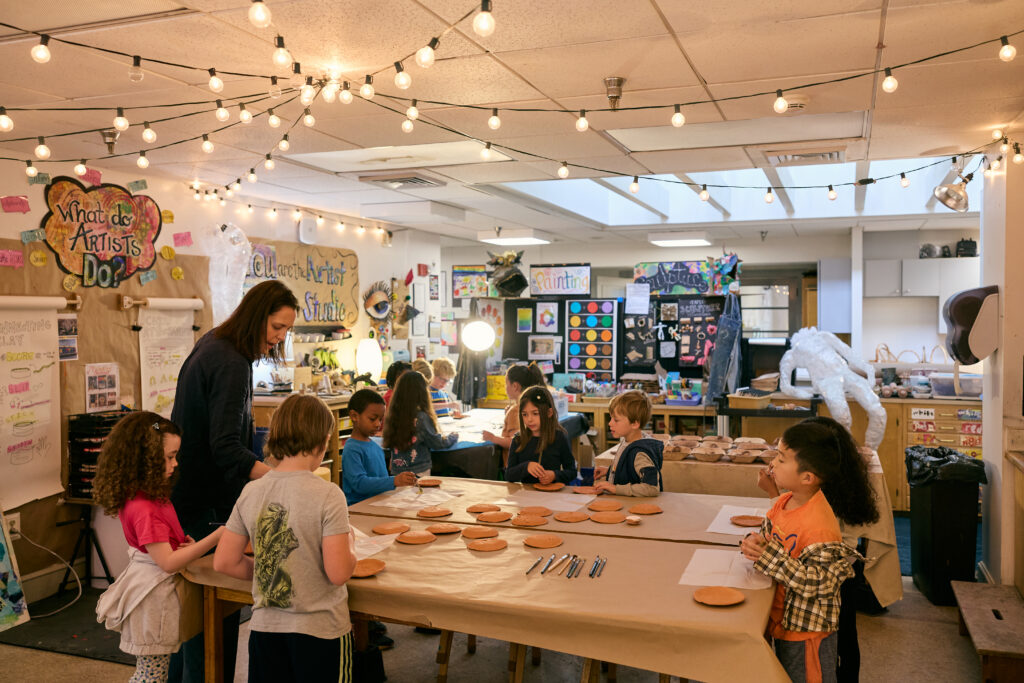
By the time students undertake their larger work, peer feedback is part of the process. They bring a piece to a “fellow artist,” who offers a compliment, asks a question, and makes a suggestion. The suggestion has to be possible. A glazed ceramic piece cannot be reshaped or turned another color. Students learn that good feedback takes the artist, the work, and the stage of the process into account.
Chesson remembers her first formal critique in college as frightening. Her work was on the wall while a room full of people discussed it and it felt intimidating. Starting young, she believes, changes the experience. A pre-K student who regularly holds up a work in progress in front of their classmates begins to understand feedback as part of the process.
Formerly a college instructor, Chesson would tell her students about the freedom visible in children’s drawings before they reached school age. Ask several three-year-olds to draw a tree, and each tree will be different. By first grade, children have become more aware of their peers, and the trees may begin to resemble one another. Why is this? Children often notice who can draw realistically. They look at a classmate’s work and decide theirs is wrong. And then adults can unintentionally reinforce the divide.
Chesson hears two responses when she tells people what she does for a living. One is, “That sounds so fun.” The other is, “I can’t even draw a stick figure.” Parents and guardians sometimes give her a similar warning about their children: one loves art; the other is an athlete and probably will not. In Chesson’s classroom that is rare. “Being an artist doesn’t just mean that you want to sit down and draw realistically for an hour,” she says. It can mean finding an unexpected way into an idea and discovering that you have something to say.
“They learn to not only see themselves as artists,” Chesson says. “They see each other as artists.” And with that, the studio becomes collaborative without everyone making the same thing.
Professional art includes sculpture, fibers, performance, abstraction, design, installation, and countless other forms. Chesson believes children deserve the same breadth in the classroom. A student who does not enjoy drawing may discover a deep interest in sewing, building, painting, or working with clay. A student may see an impressive drawing and ask its maker for help. Another may notice a friend’s unusual paint mixture and try it too. Someone builds a structure, and the next child wonders whether theirs can evolve even more. “They learn to not only see themselves as artists,” Chesson says. “They see each other as artists.” And with that, the studio becomes collaborative without everyone making the same thing.
Professional art includes sculpture, fibers, performance, abstraction, design, installation, and countless other forms. Chesson believes children deserve the same breadth in the classroom. A student who does not enjoy drawing may discover a deep interest in sewing, building, painting, or working with clay. A student may see an impressive drawing and ask its maker for help. Another may notice a friend’s unusual paint mixture and try it too. Someone builds a structure, and the next child wonders whether theirs can evolve even more. “They learn to not only see themselves as artists,” Chesson says. “They see each other as artists.” And with that, the studio becomes collaborative without everyone making the same thing.
Several years ago, one student spent class after class at the painting center. She mixed colors, layered paint, mixed more colors, and added more layers. This continued from kindergarten into the elementary grades. Her mother eventually asked Chesson whether she should be worried. Should the paintings be more recognizable by now? Chesson had been watching her child closely. “She was thoughtful about what she was doing, and she was working on something,” she says. “Her brain was working on something.” The student kept mixing. Then, in the spring of third grade, the work changed. She began producing drawings and paintings of great detail and complexity. “She had gotten what she needed,” Chesson says. A conventional sequence might have interrupted that process too early.
The benefit of teaching at Westtown is that Chesson can see what happens next. She has watched entire classes develop particular fascinations. One group became absorbed in fibers, sewing and weaving far more than any class she had taught before. Chesson worried briefly about what they had not covered, then let the interest continue. The following year, another teacher noticed immediately. The students knew how to sew! They returned to the material with confidence and moved into more complex work.
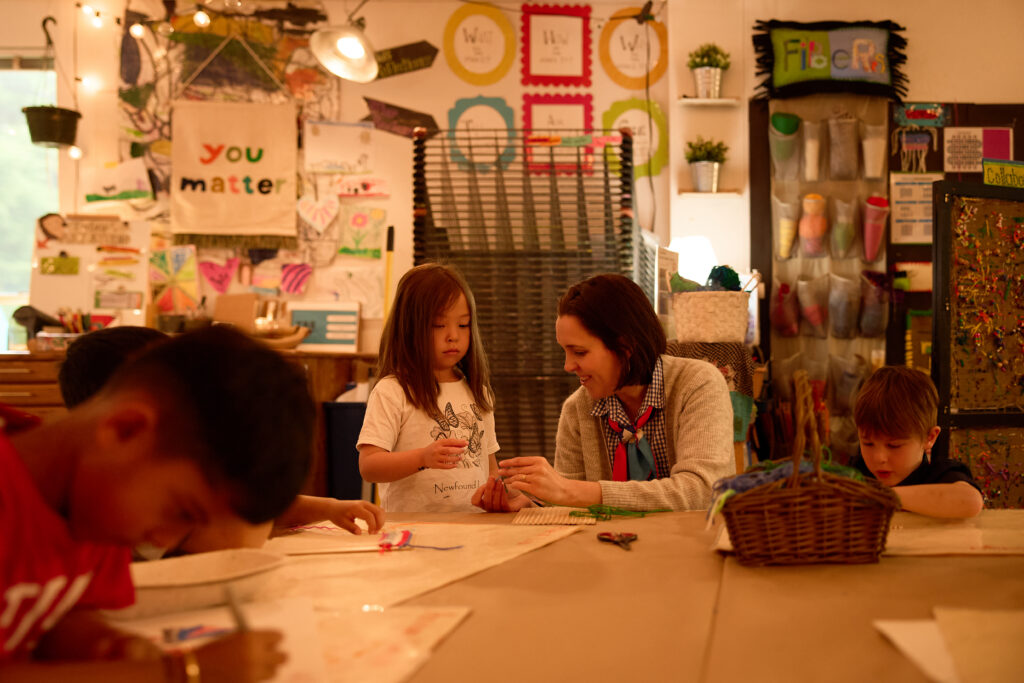
That continuity is beginning to change Chesson’s Middle School teaching, too. She originally designed her seventh- and eighth-grade elective around helping adolescents generate original ideas. Students at that age can be highly self-conscious. Creating something personally meaningful can feel vulnerable, and many arrive wanting to know what Chesson expects them to make. Now, some of the first students raised in a choice-based studio are returning to her. “They’re like, ‘Oh, I’ve got tons of ideas for my art. No problem,’” she says.
That is the part of the work that most excites her is the possibility that children may carry this way of thinking beyond the art room. The guiding ideas of a TAB studio are simple: You are the artist. This is your studio. What do artists do? Chesson hears similar possibilities elsewhere in school. A child who comes to see herself as a writer begins to approach writing differently. A student studying a book might demonstrate comprehension through a performance, a stop-motion animation, a poster, or a written response, depending on the actual goal of the lesson. Choice does not mean the absence of standards. Every pre-K student still needs to learn primary and secondary colors and how to mix them. Students practice techniques, follow safety expectations, and sometimes create work for display under specific parameters. Chesson begins by asking what children need to understand, then considers how much freedom can exist within that goal. “It’s not about me,” she says. “It’s about the artist in the space and following their lead.”
She wanted to teach in a place where her understanding of children, creativity, and learning belonged within the school rather than at its edges. She knew Westtown might be a better fit. She did not anticipate how fully the approach would be embraced.
For much of her career, Chesson felt that she was teaching against the current. Schools supported her, but the educational philosophy behind her classroom often remained separate from the broader life of the institution. Westtown felt different. When she interviewed, she told people she did not want to keep swimming against the current. She wanted to teach in a place where her understanding of children, creativity, and learning belonged within the school rather than at its edges. She knew Westtown might be a better fit. She did not anticipate how fully the approach would be embraced.
For much of her career, Chesson felt that she was teaching against the current. Schools supported her, but the educational philosophy behind her classroom often remained separate from the broader life of the institution. Westtown felt different. When she interviewed, she told people she did not want to keep swimming against the current. She wanted to teach in a place where her understanding of children, creativity, and learning belonged within the school rather than at its edges. She knew Westtown might be a better fit. She did not anticipate how fully the approach would be embraced.
Recently, Chesson has offered professional development workshops to her colleagues in the Lower School in which teachers consider the same principles as they apply to reading, writing, math, and science. The school’s Quaker belief in seeking the Light in each child gave her a familiar language for what she had been trying to do for years. “The way that teaching art is authentic to me is also authentic to the school and authentic to the community,” she says. She has met art teachers from across the country and around the world. She cannot remember meeting another who described the same degree of alignment. In her studio, that philosophy is visible before anyone names it.
Back in the Lower School artists’ studio, the four-year-old mixing paint is absorbed in what happens when one color meets another. Chesson knows just how much can be happening in that small moment and remains enthusiastic and curious to see where it will lead.


