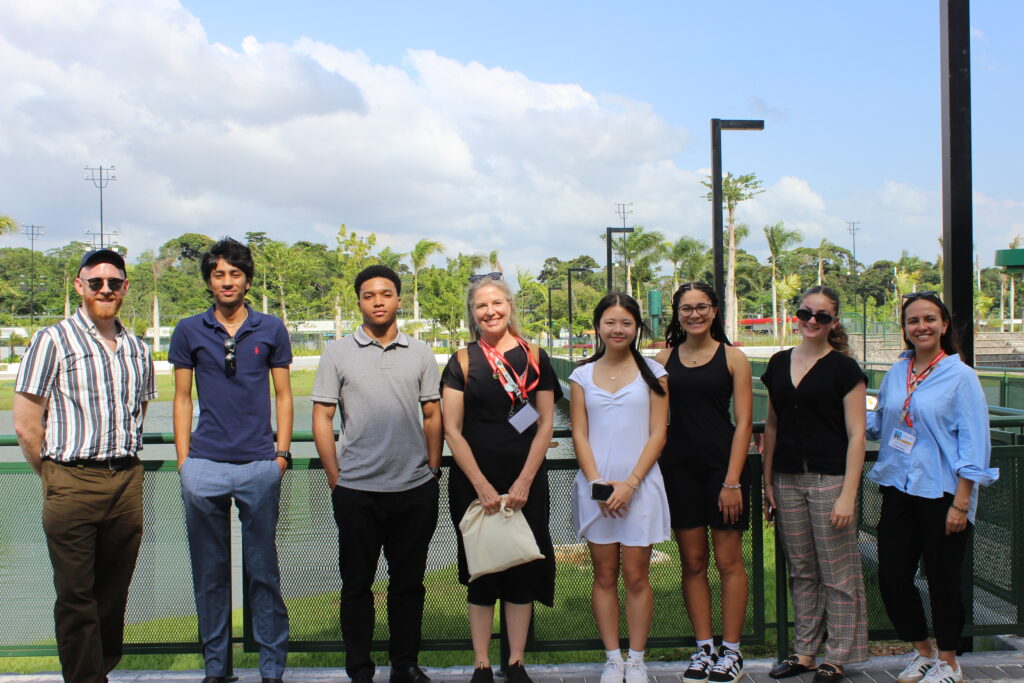
Westtown School and Germantown Friends School (GFS) sent a delegation to the United Nations COP30 climate summit in Belém, Brazil. At the thirtieth annual COP (Conference of the Parties) summit, delegates from 194 countries across the globe gathered to address the climate crisis collaboratively. At these conferences, they set goals, share their country’s progress, negotiate action plans, and formulate legal agreements.
Representing Westtown were Sarah Lan ’27, Chris Wills, Associate Head of School for Program and Community, and Francine Locke, Director of Sustainability at Westtown School and GFS. They traveled with Justin J. Harris, Executive Director of the Climate Equity Collaborative (CEC), a climate-action and education organization that focuses on youth and underserved communities. The CEC developed an immersive program for the delegates that included education and discussion sessions, rainforest tours, meetings with leaders in Indigenous communities, and volunteer opportunities—all in addition to attending COP30 sessions.
Students had the opportunity to concentrate on specific topics. Sarah—in addition to two GFS students—focused on blue carbon ecosystems, ocean restoration, and renewable energy. She was particularly interested in one of the presenters, from the State University of Amazonas, who developed a technological tool that focused on monitoring the water quality of the Amazon rivers.
The delegation also met with Keith Runyan, General Secretary, Quaker Earthcare Witness (QEW). Over a dinner together, Keith shared his thoughts on the interconnectedness between Quakerism and climate action, and the group engaged in a robust conversation together. “We made deliberate connections with Quaker organizations this year, like the QEW and the Quaker United Nations Office [QUNO],” says Wills. “To explore these really big ideas with frameworks that are simple and that our students already know and understand because we live those out here on campus every day was very valuable.”
The conference availed the students of important proximity to the mechanisms of action and allowed them a close-up look at how change can be made and at what’s both effective and ineffective in bringing about change. “In a time of shifting climate policy, the perspective of the next generation is a critical force for change,” says Locke. “COP30 provided our students with an unparalleled laboratory for climate action. By bridging the gap between the classroom and global diplomacy, we are preparing our students to serve as the advocates and stewards our planet urgently needs.”
Wills adds that students witnessed, “the interconnectedness of all of these larger systems that come together to work against climate change. Students were able to see how the levers of capitalism are functioning on a global scale and understand the ways that change can happen at a grassroots level, a policy level, and then at a global initiative level. So being able to separate those things to see where one can have an impact in different kinds of contexts was pretty incredible for our students.”