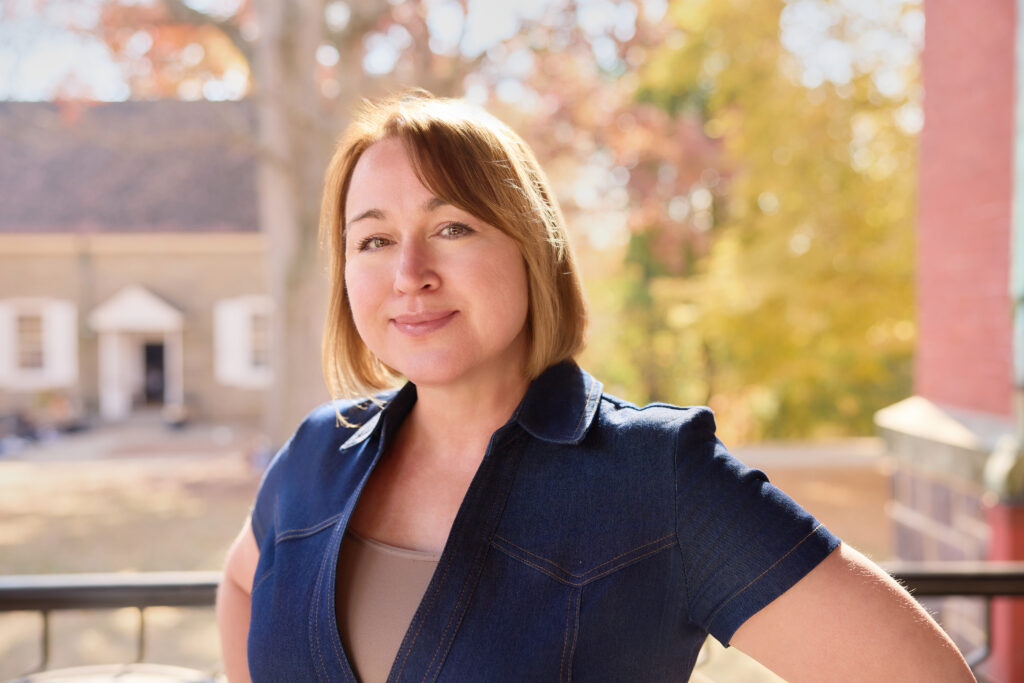
Over the summer, we were thrilled to welcome Francine Locke to our community as the new Director of Sustainability. She also serves as the Director of Sustainability for Germantown Friends School (GFS). Through an innovative partnership, Westtown and GFS created this shared role that offers both school communities the benefit of an experienced Director of Sustainability. This cross-school collaboration is generating energy and innovative ideas and already students from both schools have visited each other’s campuses to find creative and effective ways to collaborate.
Locke brings a wealth of experience and knowledge. She has a Master’s in Environmental Health from Temple University, and previously served as Chief Sustainability Officer for Delaware County and as the Director of Sustainability and Green Schools for the School District of Philadelphia. About her new position she shared, “Everyone at Westtown and GFS gets it, and that’s a beautiful thing to inherit in this position. There is already a ton of interest and wonderful people leading this work. I am working with generous, kind communities at schools that value Quakerism and sustainability. This mindset is expressed through meaningful actions that are the norm at both schools.”
Locke says she is highly impressed with the sustainability practices already in place at Westtown, noting many examples from implementing green stormwater management practices, to composting, eliminating single-use plastics, and procuring locally grown produce in the Dining Room. “From a sustainable campus perspective, Westtown is a leader in operationalizing sustainability into its facilities management program. The school’s state-of-the art building automation system allows for an efficient way to control HVAC systems within historic facilities. All of the facilities’ lights have been converted to high efficient LEDs. From a renewable energy perspective, the school purchases 100% of its electricity through renewable energy credits sourced from wind farms. There is much to be said about the sustainable campus operations at Westtown,” she says.
She also notes that, “Westtown is a true leader in education for sustainability. The campus is a living laboratory, and an outdoor classroom, and the curriculum reflects the abundance of natural resources present at the school. Teachers and students at Westtown experience education in a way that allows them to find their own connections with the natural world and sustainability, while also applying their understanding of math, science, religion, art, and other areas of study. This is an interdisciplinary approach that is not limited by subject area.”
One of Locke’s first projects is to create a sustainability plan for Westtown along with members of the Sustainability Committee—a group comprising faculty, administrators, staff, and students. “The sustainability plan will include input from the entire school community so that it becomes a product of the school’s collective thinking rather than a document that is delivered to the community for implementation,” she shares. “Communities tend to support a plan that they help create, and we want this to be a living plan that delivers measurable outcomes and reflects the Quaker values of the community. My hope is that we will develop a holistic, whole-school sustainability plan that connects education, physical spaces, and organizational culture as a sustainable system. We want to consider economic, social, and environmental issues in an interconnected way rather than as separate issues. For example, we will work towards balancing economic growth with equity to ensure that everyone is uplifted on the journey towards sustainability. Through a robust outreach and engagement process, we will identify baseline data for energy, waste, water, emissions, food, and much more. We want to then develop manageable sections or focus areas of the plan such as education, energy, zero waste, and health and wellbeing. When this framework is created, we can identify measurable targets and the actions needed to attain them. Threaded throughout the plan will also be inspiring stories of the work currently taking place at the school, including highlights of programs, practices, and people. It’s an exciting time to be here and I’m looking forward to growing more sustainability initiatives from the seeds that have been planted by my predecessors.”
Locke is also very excited about the upcoming construction of a 2.1 MW solar array. “This infrastructure will support the school’s goal of working towards a carbon-neutral campus. There is a potential to calculate carbon sequestration of the 600-acres of natural land, accompanied by the offset of carbon emissions from the new solar array and together, with reduced waste from the campus, highly sustainable procurement practices, and changes in human behavior, the school has the potential to lead the way in a more sustainable environmental footprint. This will also be a powerful educational tool for students who may be able to study the system, once again demonstrating Westtown’s campus as an innovative laboratory.”
Energized by this community and the work already underway, Locke says she looks forward to bringing her prior experience to bear in this role. “I am so grateful to be at Westtown leading the sustainability efforts of this extraordinary school. My past work involved crafting successful sustainability solutions with limited resources. As the Sustainability and Green Schools Director for the School District of Philadelphia, and the Chief Sustainability Officer for the County of Delaware, PA, I found that the development of a community-created, highly organized and results-driven plan allowed for these institutions to connect resources to prescribed actions. This led to measurable progress that could be shared out with the larger community, inspiring hope and optimism for a better world. I would like to bring this approach to Westtown, creating limitless possibilities with the vast 600-acres of mature, beautiful, preserved land, and the already-existing foundation created by my predecessors. Students are our purpose at Westtown, and I look forward to supporting their journeys to become global sustainability leaders. They will be the changemakers who crack the code to climate change and an equitable, kinder world.”