- About
- Why ‘Town
- Admission
- Lower School
- Middle School
- Upper School
- Summer Programs
- Lighting The Way
- Academic Calendar
- Athletics
- Arts
- MyWesttown
- Photos
- Give
- Summer Programs
- Alums

Carlos Charriez’s seventh-grade science curriculum provides abundant opportunities for inquiry, observation, and research. Over the fall term, students have engaged in experiential projects that challenge them to understand design, data, and analysis. Charriez also looks for opportunities to work across divisions, especially with Lower Schoolers. Charriez shares about these projects, “The first annual Lower School collaboration was a follow-up project to our Experimental Gardens Lab where students had a chance to apply the scientific method with the goal of understanding the factors that influence the growth of snap peas. Along the way, they learned how to design experiments, collect and analyze data, and ultimately grow and eat snap peas, which are tied into our unit on cells and the digestive system.
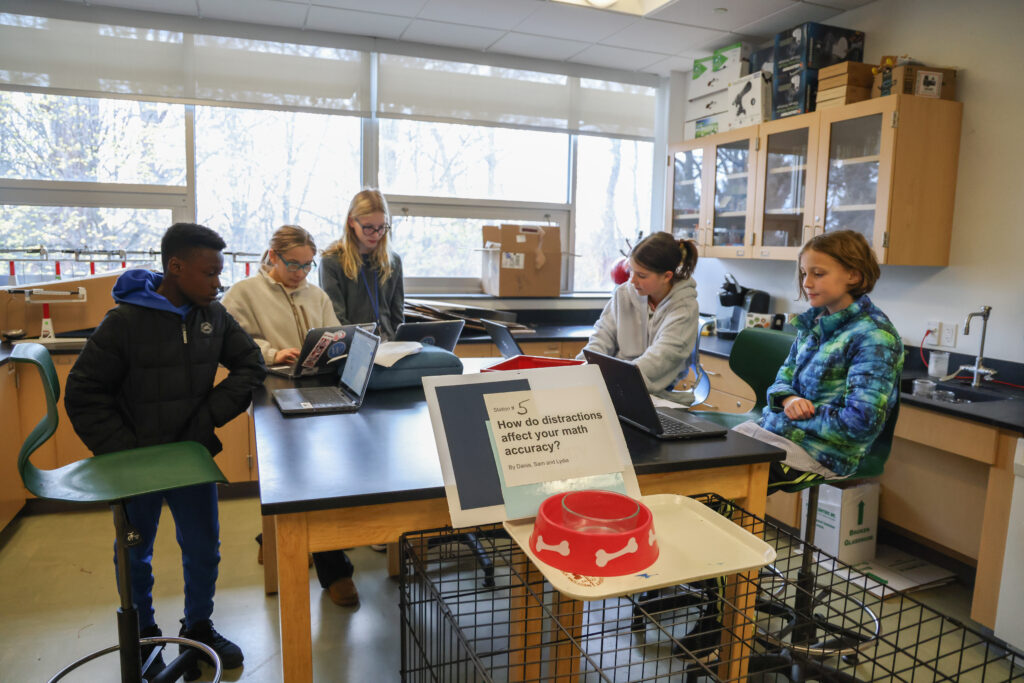
“To take it a step further, we decided to apply this process to human subjects—in this case fifth graders. They were given some physical and cognitive tasks to complete along with a variable that the sixth graders wanted to test. For example, one group wanted to see how encouragement influenced someone’s accuracy in shooting a basketball. Another group wanted to see how ‘pump-up’ music influences someone’s ability to do sit-ups. Each of these experiments had to be carefully designed and controlled to improve the accuracy and reliability of the results. While we couldn’t control every variable, students did their best to try and even the playing field as their fifth grade ‘subjects’ completed the task.”
The next week, the sixth grade students went to the Lower School to work with the fifth graders on documenting the results. “Our follow-up visit to the Lower School allowed the two grades to collaborate on graphing and analyzing the results,” says Charriez. “As this is something we do quite often in sixth grade, students were able to teach the fifth graders how to create a simple graph using Google spreadsheets, along with real-time data collected from their experiments.”
Although the fifth graders were the “subjects” of these experiments, it was a learning experience for them as well. Lower School science teacher Colby Van Alen shares, “This was a wonderful opportunity for fifth graders to not only interact with sixth graders, but to also have a sample of what is to come in sixth grade science. This collaboration sparked their imaginations into what experiments entail as well as a deeper understanding of variables and data collection, and how what seems like a simple idea can be stretched and tested. It was such an engaging and fun collaboration! Fifth graders are certainly looking forward to their turn at designing experiments next year.”